
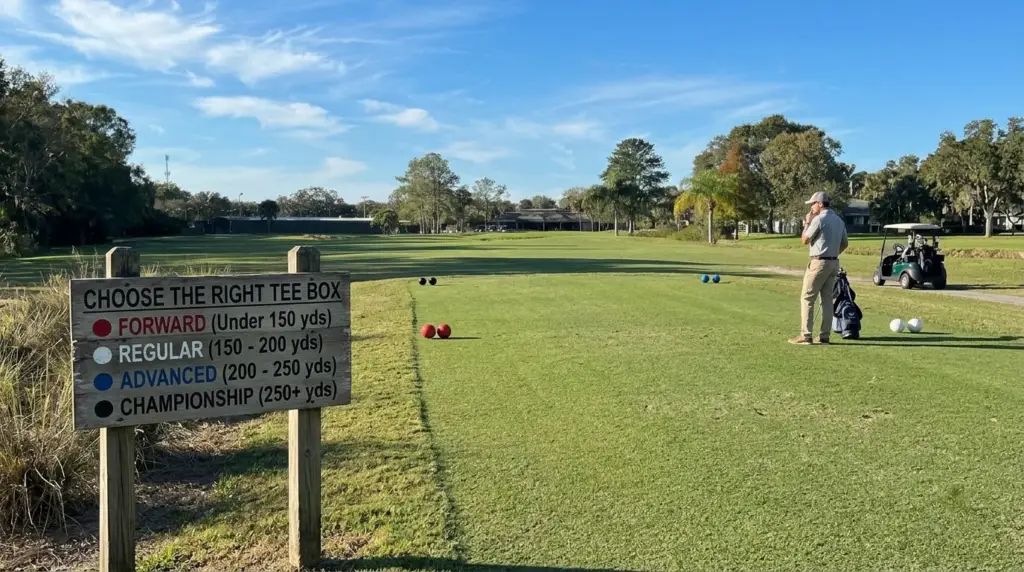
Choosing a tee box looks like the simplest decision of the day. Then one golfer walks to the back tees, the rest of the group follows, and everyone ends up playing a course several hundred yards longer than it needs to be. It happens constantly: in a USGA survey of more than 700 PGA and LPGA professionals, 92% said golfers playing from too far back is common.
Tees that are too long turn par 4s into driver-plus-fairway-wood marathons, make forced carries uncomfortable and leave greens in regulation out of reach. Tees that fit your game give you mid-irons into some greens, short irons into others, realistic par-5 chances and real decisions about when to attack a pin.
This guide explains how to choose a golf tee box based on your actual distances, not ego, age or what your friends play. It also covers how to apply it at Northdale Golf Club in Tampa, which offers four tee-box options on its 18-hole, par-72 course.
How Do You Choose the Right Golf Tee Box? (Quick Answer)
Choose the tee that lets your normal shots reach normal landing areas and gives you realistic chances to hit greens in regulation. To find it:
- Know your average 7-iron distance, including carry and roll.
- Match it to a recommended course length using the USGA’s Best Tees guidance.
- Compare that length with the tee options on the scorecard.
- Check the course for forced carries, long par 3s and hazards, and move forward if they’re demanding.
- Adjust for conditions such as wind and soft fairways.
- Review your approach clubs after the round, then move forward or back next time.
When you’re between two tees, start with the shorter one. You can always move back next round.
Why Tee Selection Matters
Every hole is designed around distances, angles, hazards and decisions. Picture a par 4 where the architect expects a typical player to hit a drive and then a 7-iron or 9-iron. From tees that are too long for you, the same hole becomes driver and hybrid, and the bunker meant to shape your approach barely matters because reaching the green is the whole challenge. The hole doesn’t become more strategic. It just becomes longer.
The USGA describes the right tees as ones that let you:
- Comfortably reach fairways on par 4s and par 5s
- Get near most greens in regulation
- Use a variety of clubs for approach shots
That last point is a useful check. Across 18 holes, you should hit wedges, short irons, mid-irons, a few long irons or hybrids, and the occasional fairway wood when a hole truly calls for one. If nearly every par 4 needs driver plus your longest club, the course is playing too long. If nearly every par 4 is driver-wedge and par 5s feel like two-shot holes, you may want more challenge.
Use Your 7-Iron Distance as a Starting Point
The USGA’s Best Tees system recommends course length from one reference club: the 7-iron. It was chosen because most golfers know their 7-iron distance better than their driver distance, and a driver number is often based on the best drive someone remembers rather than a typical one.
The number that matters is how far your normal 7-iron goes, not how far it can go. If one perfect strike flies 165 yards but most finish around 145, use 145.
How to Measure Your Real 7-Iron Distance
- Use launch monitor data during a practice session.
- Track well-struck shots on the course with GPS.
- Hit a series of 7-irons at a range with reliable distance information.
- Ask a golf professional to help confirm your number.
Base it on a series of shots, not one unusually good swing. You’re choosing tees for the golfer who plays all 18 holes.
USGA Best Tees: 7-Iron Distance vs Course Length
| Average 7-Iron (Total Distance) | Recommended Par-72 Course Length |
| 140 yards | 5,900–6,100 yards |
| 125 yards | 5,400–5,600 yards |
| 80 yards or less | 3,500–3,700 yards |
For a number specific to you, the USGA’s Best Course Length Calculator uses your 7-iron distance and the course’s mix of par 3s, 4s and 5s. Choose the tee whose total yardage is closest to your result.
What About Driving Distance?
Driving distance still helps, and earlier systems such as Tee It Forward matched golfers to course length using average driving distance. The key word is average.
If your typical drive goes 205 yards, a strong one goes 220 and your all-time best went 247, base your decision near 205. The course asks you to produce playable distance again and again. Choosing tees for your maximum turns ordinary par 4s into holes that need two exceptional shots just to reach the green.
Should You Choose a Tee Box Based on Handicap?
Handicap adds context, but it shouldn’t decide alone. It describes how well you score, not how far your shots travel. Compare two 17-handicap golfers:
| Player One | Player Two | |
| 7-iron | About 145 yards | About 120 yards |
| Driver | About 225 yards | About 180 yards |
| Handicap | 17 | 17 |
| Strength | Consistent ball striking | Putting and chipping |
| Weakness | Short game | Distance |
Same handicap, different games. Player One has the distance for a longer layout. Player Two scores just as well through the short game, but the same yardage would leave long approach after long approach. Use handicap alongside distance, and never let it override clear distance limits. To understand what your handicap actually measures, read our guide to how the golf handicap system works.
Tee Markers Are Distance Options, Not Identity Labels
Many golfers still call forward tees “ladies’ tees” and the back set “championship tees.” Those labels don’t help. A woman who drives it 230 yards may suit a longer set than a man who drives it 175. A powerful 65-year-old may comfortably play farther back than a short-hitting 30-year-old beginner.
The USGA’s own tools do include average distances for male and female golfers, but they build the recommendation from how far you hit the ball, not from the label on the marker. Treat each tee as a playing distance and the choice gets much easier.
3 On-Course Tests to Check Your Tees
You can run these during any normal round. Judge them after decent shots, not perfect ones.
The Approach Shot Test (Par 4s)
Note the club you hit into par 4s after a decent drive. If most approaches need fairway woods, long hybrids or your longest irons, the course is too long. If nearly every one is a wedge, it may be shorter than you need. A good fit mixes in a hybrid or fairway wood, several mid-irons, several short irons and a few wedges.
After the round, ask yourself one question: when I hit a decent tee shot, did I have a reasonable chance to reach the green in regulation? If the answer keeps being no, moving forward isn’t admitting defeat. It’s correcting the setup.
The Par-3 Test
A long par 3 belongs on a good course. If most par 3s need a fairway wood just to reach the green, though, you’re probably too far back. If every par 3 is a wedge in good conditions and you want more challenge, try moving back for a better mix of shots.
The Par-5 Test
From the right tees, most recreational golfers should reach a par-5 green with a reasonable drive, a solid second shot and a realistic third. If three good shots regularly leave you short, move forward. If most par 5s become driver plus a mid-iron, much of the hole’s intended strategy has disappeared.
Look Beyond Total Yardage: Forced Carries and Course Design
Two courses that both measure 6,000 yards can play very differently. One may have open fairways and simple green entrances. The other may have water in front of tees, long carries over hazards, elevated greens, doglegs, narrow landing areas, deep bunkers and penalty areas that limit rollout.
The USGA notes that course playability should influence your choice, and that on a demanding course, moving forward from your usual length can make sense. That matters in Florida, where water often shapes strategy. Northdale’s Ron Garl design moves through ponds, mature oaks and rolling fairways, so check individual holes instead of relying on the scorecard total. Our guide to golf course slope rating explains how difficulty is measured beyond yardage.
How Weather Changes the Right Tee
Your best tee can change from one round to the next.
Wind
Strong wind adds effective distance, especially on exposed holes. Moving forward keeps the course playable.
Rain and Soft Fairways
After heavy rain, drives get little rollout. A 220-yard tee shot on firm ground can finish well short of that on soft turf.
Temperature
Cooler air reduces ball distance. Warm weather helps distance, but Tampa heat and humidity also add fatigue, and a long, demanding round becomes harder to enjoy. Our tips for golfing in Tampa’s summer heat can help on those days.
Course Setup
Pin locations, rough height and green firmness also change how hard a course plays.
When to Move Forward or Move Back
Signs Your Tees Are Too Long
Beyond failing the tests above, watch for these signals:
- Forced carries routinely exceed your normal distance.
- You need exceptional shots just to reach ordinary landing areas.
- Your group spends extra time searching for balls after swings aimed at extra distance.
- You finish rounds feeling the course never gave you real scoring chances.
Signs You’re Ready to Move Back
- You regularly drive into hazards meant to challenge second shots.
- Par 4s not designed to be drivable become reachable.
- You rarely use mid-irons or longer approach clubs.
- The course no longer offers enough strategic challenge.
How to Test a Change
Don’t decide off one round, good or bad. When a pattern repeats, play a full round from the new tee and compare. Did you use more clubs, reach more greens, make more strategic decisions and move along more smoothly? If so, you’ve likely found a better fit.
Does Moving Forward Make Golf Too Easy?
No. Bunkers, water, trees, rough, uneven lies, chipping, putting and course management all stay in play. What changes is that good shots start earning the opportunities the course was designed to create.
Say a good drive leaves you a 7-iron into a green guarded by water. Now you face a real choice: attack the flag, aim at the center or favor the safe side. From 50 yards farther back, that second shot becomes a 3-wood just to reach the front edge, and the strategy disappears because you’re only trying to get there. The right tees don’t remove challenge. They bring the intended challenge back. Our list of common course management mistakes shows how much scoring depends on those decisions.
Can Golfers in the Same Group Play Different Tees?
Yes. A foursome might include a long-hitting low handicapper, a moderate-distance recreational player, a beginner and a senior whose distance has dropped. Forcing all four onto one tee makes the day worse for at least one of them. Each golfer can play the tee that fits their game while the group still plays every hole together, and Northdale’s four tee options make that easy for mixed-ability groups.
Does Tee Selection Affect Pace of Play?
It can. USGA research ties the right tees to greater enjoyment, and fitted tees cut common delays: fewer lost balls, fewer extra strokes just to reach scoring position and fewer recoveries from hazards a player can’t carry. Slow routines are still slow, though. Forward isn’t automatically faster either, since a long hitter on short tees can end up waiting to reach drivable par 4s and par 5s. The best pace comes from tees that fit each golfer. For realistic round times, see how long 18 holes of golf takes.
Tee Box Advice for Beginners and Senior Golfers
Beginners: Start Forward
Shorter tees help new golfers reach playable areas more often, hit more successful shots, keep pace, lose fewer balls and learn how holes are meant to unfold. As distance and consistency grow, experiment with moving back. Starting forward doesn’t limit your development. It makes room for it. Northdale also shares how it helps beginner golfers in Tampa.
Senior Golfers: Play the Game You Have Today
Distance naturally changes over time, and tees that fit ten years ago may now mean too many long approaches. Instead of asking which tees you’ve always played, ask which tees fit your current game. Moving forward can restore the kind of golf you enjoyed before. Read why Northdale is a great public course for senior golfers.
Casual Rounds vs Competition
In leagues and tournaments, the event may assign tees or set up divisions, so follow its rules. If you’re joining organized play, our guide to how golf leagues work in Tampa covers what to ask before your first round. For casual golf, nobody gives a prize for choosing the longest course you can survive. Pick the one you can actually play.
Choosing Your Tees at Northdale Golf Club in Tampa
Northdale is a public 18-hole, par-72 course designed by Ron Garl, with four tee-box options and a layout of ponds, mature oaks and rolling fairways that rewards more than raw distance. Before your round, bring your average 7-iron and driver numbers, check the day’s conditions and think about the abilities of everyone in your group. If you’re unsure, try the slightly shorter option first and see how many different clubs you use.
Learning the layout also helps you judge where carries and angles matter, which our guide to course layout and strategy at Northdale walks through. When you’re ready, book a tee time at Northdale and put your new tee choice to the test.
Frequently Asked Questions About Choosing Golf Tees
What is the average 7-iron distance?
USGA data puts the average 7-iron at about 138 yards for male golfers and 100 yards for female golfers. Those averages line up with recommended par-72 course lengths of roughly 6,100 and 4,437 yards.
Can Northdale’s staff help me choose a tee?
Yes. If you’re unsure which of Northdale’s four tee boxes fits your game, ask the golf staff in the pro shop before your round.
Do I need a membership to play Northdale?
No. Northdale is a public golf course with no membership required. You can book online, walk in or call to set up your round.
Play the Course That Fits Your Game
The right tee should still challenge you. You should need a long club now and then, play away from trouble on some holes and pay for poor shots. But good shots should earn something, too: a solid drive should regularly leave a realistic shot at the green, par 3s should call for different clubs, and par 5s should give you choices.
Start with your normal 7-iron, factor in your driver, the course design and the day’s conditions, and adjust after each round. If your game grows until your tee feels too short, move back. Until then, play the distance that lets you enjoy the course the way it was designed.
Northdale Golf Club
4417 Northdale Blvd, Tampa, FL 33624
(813) 962-0428 | Contact Us